
Dancing with Aimlessness
Weaving the flows of blood, spiritual, and cosmic ancestors into a life that is not my own

“If you go to the edge with your awareness, and stay there, or return there, that is all it needs; it will do the rest for you” - Eugene Gendlin
Since emerging from my wandering retreat towards the end of 2024, I have attempted to live from a space of emergence, wishing to attune to a different way of being that seemed to stir and thresh at the “edge of my awareness”. Looking more deeply as I write this, I realize I was attempting to orient to the practice of aimlessness (Sanskrit: apraṇihita).
“Aimlessness means you don’t put anything in front of you as the object of your pursuit. What you are looking for is not outside of you; it is already here.”
-Thich Nhat Hanh, The Three Doors of Liberation
The absence of a specific pursuit made possible the presencing of what is “already here”; a doorway into ‘deep data’1 stirring at the depths of my being. Ever so often, someone would ask me some version of: “So, what are you working on these days?” Fugitively, the currents of aimlessness would translate the question into: “What is unfolding, now?” Hence, every such conversation become an opportunity for me to inquire and share freshly about what was cooking in my inner kitchen — I bow to you for drawing me out and giving me a chance to reflect; I am, because of you.
For the last ~1.5 years, my central inquiry has been: "How might I be in the world, but not of the world?” What I offer here is an unfolding of that thread and a crystallization of what seems to be emerging.
Continuation
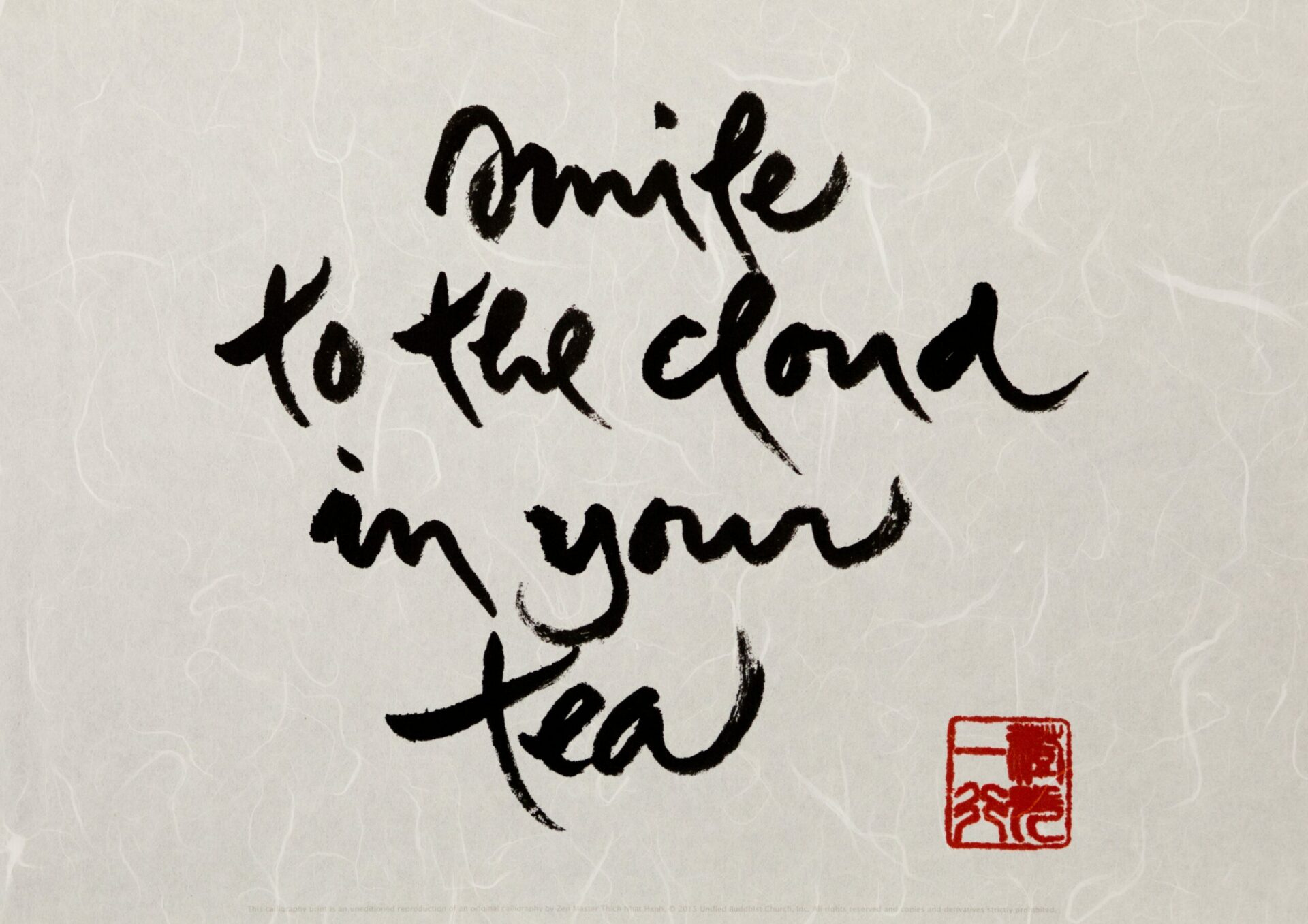
It has become something of an annual ritual for my wife and I to welcome the Gregorian New Year at the year-end ‘Holiday Retreat’ in Thai Plum Village, a Zen monastery in the tradition of Thich Nhat Hahn. In this tradition, instead of saying “Happy Birthday!” we say “Happy Continuation Day!”
"Imagine a teapot. We put some tea leaves into the pot, pour boiling water in, and after waiting a few minutes, we pour out the tea. That tea is the continuation of the tea leaves. As the tea is drunk, we can see that the tea is in us, the teacup, and the person drinking the tea. When that person who drinks the tea writes poetry or calligraphy, we can also see the tea in the poetry and calligraphy. The tea is on a journey...”
-Thich Nhat Hanh, Reincarnation (p. 17)
As Eugene Gendlin remarked: “Nothing just ‘is’. Every occurring is also an implying of further occurring.” Nothing truly is born or dies; everything is in constant transformation.
As a way of consciously ‘continuing’ into the new year, part of the retreat involves writing down one’s new year’s aspiration on a piece of paper, and offering it to a fire after the stroke of midnight in the new year. Intentions shape our speech and actions which ripens as particular fruitions, as the Buddha famously uttered:
Intention shapes experiences;2
intention is first, they’re made by intention.
If with pure intent
you speak or act,
happiness follows you
like a shadow that never leaves.
-Dhammapada 1
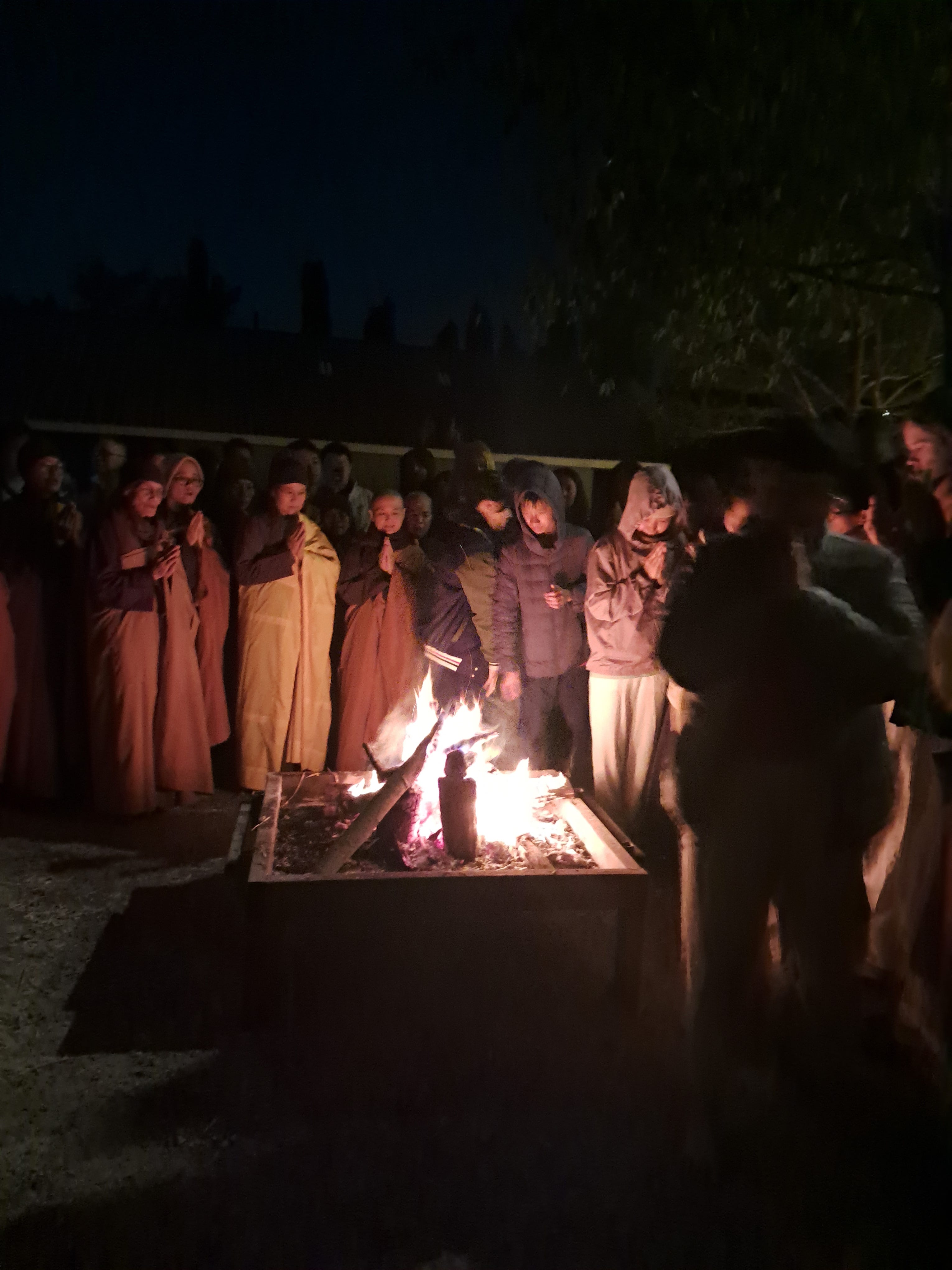
Usually, I would wait until the very last minute to write my new year’s aspiration down, wanting to afford myself the most time possible to reflect. This year however, I was lovingly put on the spot by a monk to share my aspiration in a small group two days prior to the New Year. What came forth spontaneously was this:
“To be a continuation of my blood, spiritual, land and cosmic ancestors.”
Typing this now, I feel a wave of resonance pulsing through my body. What is noticeably absent is agentic language (I/me/mine).
“A flower is made only of non-flower elements, such as chlorophyll, sunlight, and water. If we were to remove all the non-flower elements from the flower, there would be no flower left. A flower cannot be by herself alone. A flower can only inter-be with all of us… Humans are like this too. We can’t exist by ourselves alone. We can only inter-be. I am made only of non-me elements, such as the Earth, the sun, parents, and ancestors.” — How to Love, Thich Nhat Hanh
Increasingly, I feel my life is not my own — I am an unfolding continuation of cosmic, ancestral and more-than-human flows.
G. I. Gurdjieff, Mystic and Spiritual Teacher, wrote of five obligatory human strivings in his seminal book Beelzebub’s Tales to his Grandson. Cynthia Bourgeault, Modern Mystic and Fourth Way Teacher, explains that these strivings “lay out what Gurdjieff saw as the fundamental obligations attendant upon all human beings if we are truly to play our intended role in a greater cosmic ecology.” The fourth striving, in particular, speaks to the natural response that follows from realizing that one is indeed a continuation of “non-me elements”:
“…the striving, from the beginning of one's existence, to pay as quickly for one's arising and individuality, in order to be free afterward to lighten as much as possible the sorrow of our Common Father.”3
You might be able to accept that each one of us is a continuation, but ‘paying’ for the cost of one’s arising? Surely this takes it too far? Cynthia addresses this, echoing Thich Nhat Hanh’s insight of interbeing:
“When we open our eyes to the interconnectedness, entitlement begins to give way to co-responsibility. All work requires the expenditure of energy, including the work of getting you here, and according to Gurdjieff, that debt “owing to the cosmos” must be repaid…
To “pay the cost of our arising” means to understand our place in the whole, neither over-estimating nor underestimating its importance. It means realizing that by virtue of the cosmic effort invested in our existence we bear it some responsibilities, and in whatever way we can, leaving the planet a better place than we found it.”
What might it mean to “genuinely understand our place in the whole”?
Ancestral Flows
“We become only through participation; there is no becoming that is not already a participation-with.” - Bayo Akomolafe
To understand one’s place in the whole is a profound, ever-unfolding contemplation.
To explore this, I would like to share an excerpt of Thich Nhat Han’s writing from The Art of Living (I have also included an AI-generated musical contemplation if you are so inclined). As you contemplate the text, notice in particular what body felt-senses and flows arise:
I see that this body—made of the four elements—is not really me, and I am not limited by this body. I am the whole of the river of life, of blood ancestors and spiritual ancestors, that has been continuously flowing for thousands of years and flows on for thousands of years into the future. I am one with my ancestors and my descendants.
I am life manifesting in countless different forms. I am one with all people and all species, whether they are peaceful and joyful or suffering and afraid. At this very moment I am present everywhere in this world. I have been present in the past and will be there in the future…
I see that I am like a wave on the surface of the ocean. I see myself in all the other waves, and I see all the other waves in me. The manifestation or the disappearance of the wave does not lessen the presence of the ocean…
I am able to see my presence before this body manifested and after this body disintegrates. I am able to see my presence outside this body, even in the present moment. Eighty or ninety years is not my life span. My life span, like that of a leaf or of a buddha, is immeasurable. I am able to go beyond the idea that I am a body separate from all other manifestations of life, in time and in space.
If you like, you might journal or simply note down what came up for you. If you want to go further, you might even trace the ancestral flows of your blood, spiritual, land and cosmic ancestors. Here’s my own tracing:
Blood Ancestors: I am the blood continuation of Chinese, Indian and Malay ancestors. Through love and karma, I have also entered the stream of Korean ancestors.
Spiritual Ancestors: I am the spiritual continuation of Abrahamic, Buddhist, Confucian, Shamanic and Vedic ancestors, and am a child of the modern psychological traditions.
Land Ancestors: I was forged in the modern city-state crucible of Singapore, and have been gratefully received on Korean lands.
Cosmic Ancestors: I am a child of interpenetrating flows of order and chaos beyond space and time.
The Underlying Pattern
Taking this a step further, you might inquire:
Where have these entangled, inter-penetrating ancestral flows led you to?
What might be the underlying pattern?
For me, they led to an earnest seeking of truth, a fierce independence, and an insatiable impulse to connect the dots. They have also led to particular ‘mutations’ where the form I embodied seemed markedly different from what had come before — swapping business formal for monastic robes; leaving the ‘halls of power’ to wander in the Himalayas.
It is almost as if these ancestral flows have ongoingly, yet seemingly discontinuously, propelled me to move and flow between disparate worlds, breaking the shell of what I take to be me. Yet, there seems to be underlying pattern. No matter where I am, however I might resist, these flows seem to always (re-)direct me over and again into the deep waters of seeking truth.
In 2018, after exploring monastic life and deciding to continue as a lay-person, I was ordained as a member of Thich Nhat Hanh’s Order of Interbeing, a community of laypeople and monastics that take the vow to live their lives for the benefit of all beings through the continuous practice of mindfulness, ethics, and compassionate action in society. For the Buddhist-inclined, this is similar to taking Bodhisattva vows.
When one receives ordination in the Order of Interbeing, one also receives a Dharma name that expresses one’s aspiration and serves as a lifelong contemplation.
The Dharma name I received was Chân Khai Biểu (真開表):
‘Chan’ literally translates to real, but more accurately means ultimate reality
‘Khai’ translates to open
Biểu is a little harder to translate, but it means something like manifestation
When I first received the name, I simply translated as ‘True Manifestation’. Unknowingly, and in hindsight, the name also held within it an implicit inquiry:
What wants to be manifested?
Somewhere in the middle of the year-end retreat in Thai Plum Village, I stumbled upon these words on a random pillar that struck me like a lightning bolt:
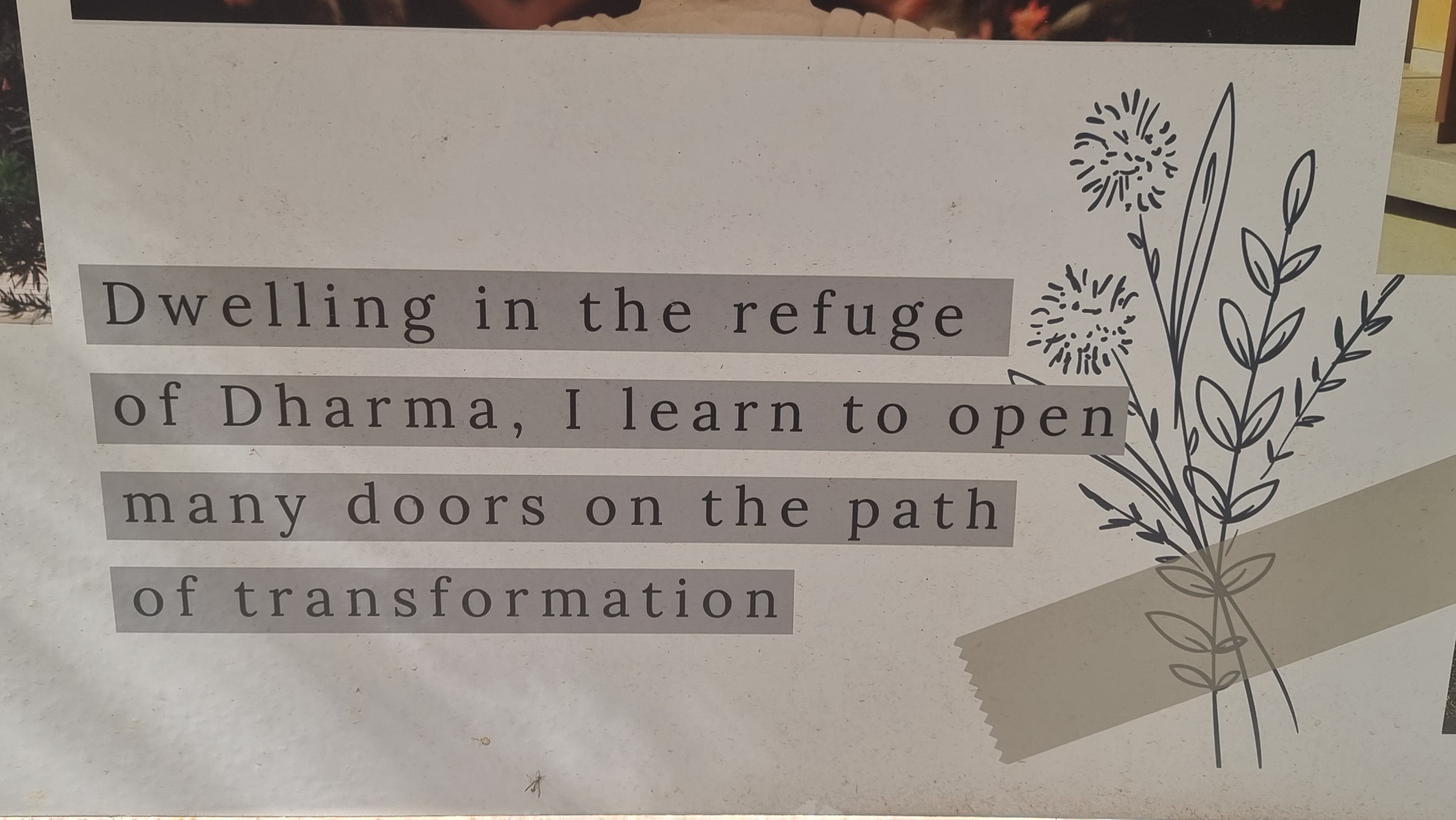
Though this wasn’t my first encounter with these words, in that moment it became like a key to decode the aspiration embedded within my Dharma name: Dwelling in the truth (Dharma), I learn to open (Khai) many doorways and pathways that allow for reality (Chân) to manifest (Biểu) in the world.
Retrospectively, I realize I have already explored two iterations of this aspiration:
‘Pull’: Becoming an avatar of truth and inspiring others — monk
‘Push’: Bridging the world of wisdom with the world of work — mindfulness
Being a monk was the most overt expression of my aspiration and a beautiful path unto itself, but for me was limited by the waning interest in organized religion in an increasingly secular and desacralized world. This was the path of ‘pull’; going to a place like a temple, beyond tourism and cultural habit, requires acting from one’s own volition and some openness to religious forms. Further, even if one were to show up at a temple, it may not be easy to see through religious forms and discover their underlying essence — spirituality. As someone forged through the ongoing entanglement of worlds, I felt called to explore a path that was not as limited by form.
This led me to the second iteration of ‘push’ i.e., bringing wisdom traditions to the place where moderns spend most of their time — the world of work. While the work was both challenging and rewarding, my experience has been that wisdom pathways are more often than not reduced to tools for optimization and performance; the ‘path’ is reduced to a ‘toolbox’. This is not for a lack of good intentions, but the reality of work in a neoliberal, technologically-oriented world. I say this while also acknowledging that such work has the potential to reduce suffering, and might even offer glimpses into reality. Nonetheless, I was running up against the edge of what I felt could be offered, and wanted to go deeper.
This is the heart of what I’ve been dancing with: How can I go deeper in opening doorways and pathways that allow for reality to manifest in the world?
From the view of aimlessness, what I’m seeking is already here.
What is already here? The underlying pattern. I have but to genuinely presence it.
Where the Pattern Leads
“The ‘Present’ is not identical with the ‘moment’ but is the undivided presence of yesterday, today, and tomorrow…”
—The Ever-Present Origin, Jean Gebser
A genuine presencing of the underlying pattern requires attuning to what Howard Thurman, Christian Mystic, refers to as “the sound of the genuine”. Such an attunement can be supported by a contemplative practice like walking in nature or meditating in silence. From that inner space, you might inquire into:
Where might the underlying pattern lead to?
What wants to be born?
For me, the underlying pattern is the seeking of truth, with a particular fierce independence and an impulse to connect the dots.
In sensing into what wants to be born, the image that comes up is that of a weave. Unlike the market-centric imagery of ‘push’ and ‘pull’, a weave has no agenda of selling anything; it is simply interested in connecting threads into an unfolding tapestry.
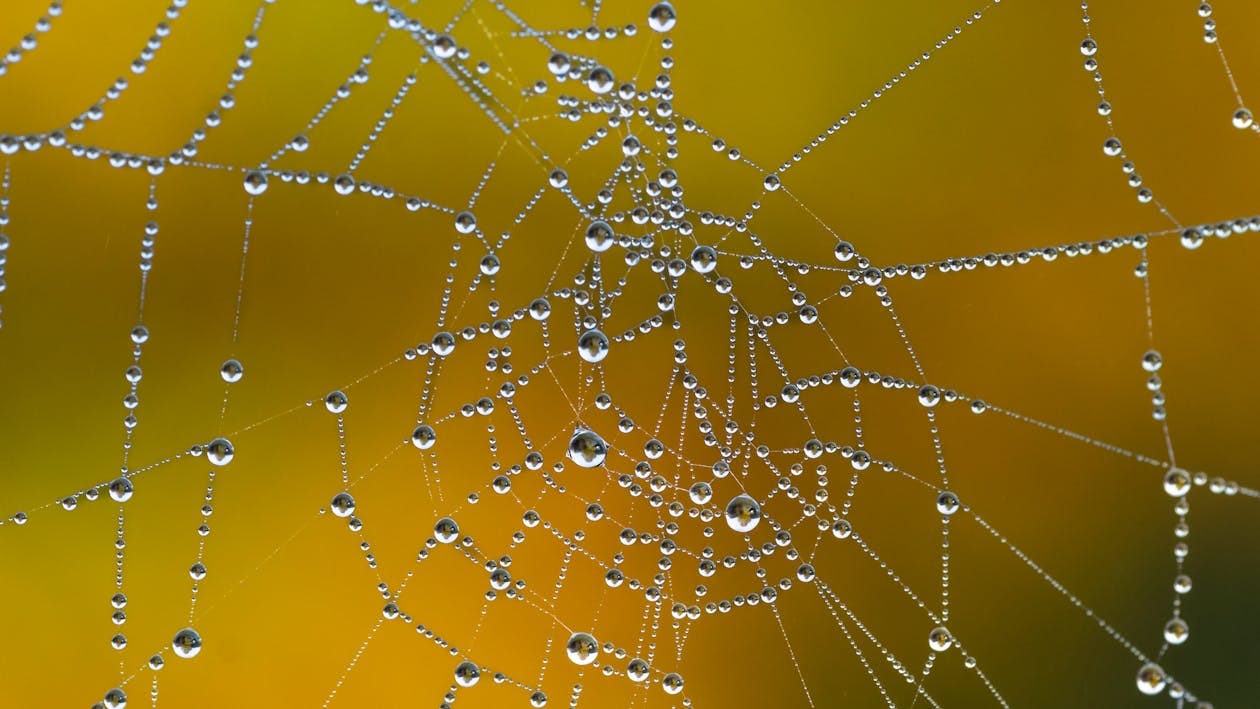
What might I be weaving? Doorways and pathways that lead to reality.
What are doorways and pathways that lead to reality? While there are vast array of paths across the many traditions, each with their own validity, it is often the way of mysticism that leads to an unmediated, naked knowing of reality.
“Mysticism means direct, immediate experience of ultimate reality. For Christians, it is union and communion with God. For Buddhists, it is realization of enlightenment.”
— Brother Wayne Teasdale, The Mystic Heart (p20)
In the Tibetan Buddhist tradition of Dzogchen, the most essential practice is known as ‘Guru Yoga’ (Tibetan: Lamai Naljor / Wylie: lamai rnal ‘byor). To the uninitiated, this might seem like a practice of guru devotion. Quite the contrary, according to Chögyal Namkhai Norbu Rinpoche, Dzogchen Master, in his book Guru Yoga (p16):
“nal indicates the real condition as it is, in which there is nothing to change or modify, while jor signifies having knowledge. This is the state of the Guru. To be in the state of Guru Yoga then, is the principal point of the practice of Dzogchen.”
In other words, Guru Yoga is the state of being in knowledge of the real.
This may seem like an audacious aspiration, but it is also eminently practical for me.
I mused in my reflections on wandering retreat that “I long for the wildness of the Himalayas that demanded of me an open-hearted, full-bodied attunement to reality, yet I am a modern deeply embedded in the neoliberal capitalist world.”
In turning to the mystics, I am seeking how I might personally embody a line from the Buddha’s Discourse on Happiness that for me captures the essence of mysticism:
”To live in the world with your heart undisturbed by the world, ever-flourishing, dwelling in freedom — this is the greatest happiness.”
From the lens of the Naqshbandi Sufi tradition, I am seeking to explore how I might practice Khalwat dar anjuman (solitude in the crowd) — living in the world (‘the crowd’, with my heart undisturbed by the world (‘solitude’).
There is also a macro context for what I’m hoping to explore, but that is another post for another time. I will also have more to share on the form this weaving of the mystical traditions might take. For now, I leave you with one of the primary inspirations for the current iteration of my aspiration.
Towards a Mystical Commons
Growing up in Singapore, one of my then taken for granted sights were places of worship from different traditions in close proximity to each other, even side-by-side:
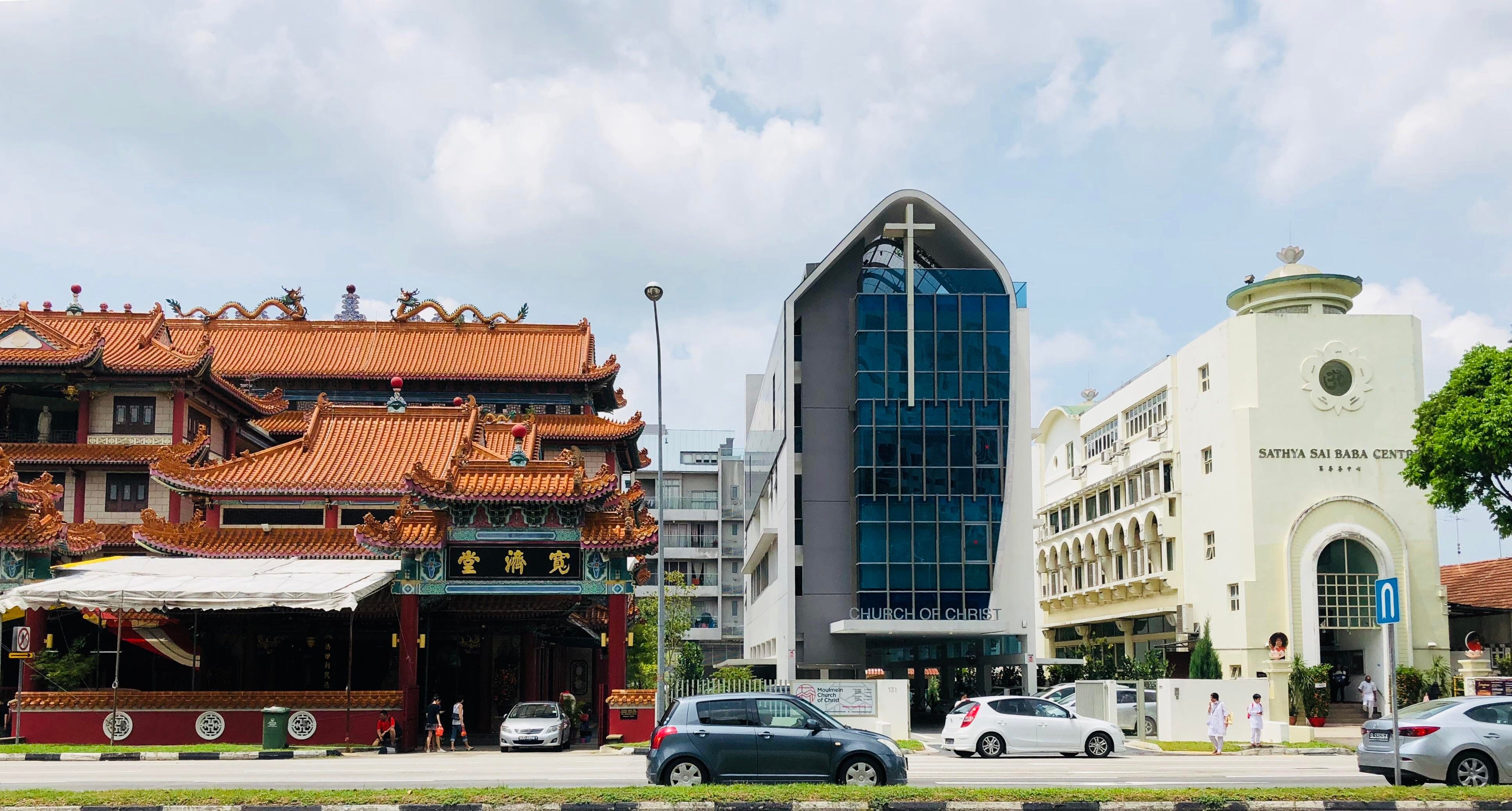
While there is religious tolerance and even harmony, I wonder if a deeper understanding might be possible. Like trees in a rainforest, I wonder if there might be subterranean mycorrhizal flows interpenetrating the distinctive mystical roots of each tradition, drawing from each tradition and inter-nourishing other traditions in deep mutuality. I can even imagine these flows beneath the concrete in the image above.
Thankfully, I don’t have to stop at my imagination — there is a profound example of this in recent history.
From 1984-2005, Father Thomas Keating, Trappist Priest, invited spiritual teachers from a variety of the world’s wisdom traditions to gather annually “to meditate together in silence, and to share our personal spiritual journeys, especially those elements in our respective traditions that have proved most helpful to us along the way”.
Unlike most inter-religious events where teachers would speak for a tradition on a particular topic in public, the ‘Snowmass’ conference4 invited spiritual teachers to speak from a tradition about their personal experience, away from the public eye with no pressure to perform and no recordings kept.
As “trust and friendship grew”, the group was “moved to investigate various points that we seemed to agree on”. The exploration of this over the first ~4 years led to the following eight points of agreement:
The world religions bear witness to the experience of Ultimate Reality, to which they give various names.
Ultimate Reality cannot be limited by any name or concept.
Ultimate Reality is the ground of infinite potentiality and actualization.
Faith is opening, accepting, and responding to Ultimate Reality. Faith in this sense precedes every belief system.
The potential for human wholeness — or, in other frames of reference, enlightenment, salvation, transcendence, transformation, blessedness — is present in every human being.
Ultimate Reality may be experienced not only through religious practices, but also through nature, art, human relationships, and service to others.
As long as the human condition is experienced as separate from Ultimate Reality, it is subject to ignorance and illusion, weakness and suffering.
Disciplined practice is essential to the spiritual life; yet spiritual attainment is not the result of one's own efforts, but the result of the experience of oneness with Ultimate Reality.
These points of agreement continue to deeply inspire me. Of particular significance for me is the first and forth agreement, which point out “opening, accepting and respond to Ultimately reality… precedes every belief system”, and that the heart of all the world religions is a “bearing witness to the experience of Ultimate Reality”. In the words of Brother Wayne: “The mystical life is the common thread running through all traditions”.
It may also be important to highlight the fifth agreement, which notes that the “potential for human wholeness… is present in every being”; it is not the exclusive domain of Olympian contemplatives. To quote Brother Wayne again “[mysticism is] really the story of every person who awakens to himself or herself —to the mystery within, without, and beyond us. Everyone of us is a mystic.”
In the afterword of ‘The Common Heart’, the first public report of the Snowmass conference after its conclusion, Father Thomas offers the following reflection, making an important distinction that the work of seeking common ground is not an attempt at homogenization:
“All who seek to participate in Ultimate Reality are united in the same fundamental search. They relate to all of genuine value in every spiritual path. They resonate to human values wherever they can be found, whether in religions, science, art, friendship or service to others. True unity is thus expressed in pluralism: unity in the experience of the ultimate values of human life; pluralism in our response to these values in the concrete circumstances of life.”
Father Thomas goes on to reflect:
“Those who seek Ultimate Reality perceive themselves as citizens of the Earth. Their first loyalty is to the entire human family. They transcend the particularities of race, nationality and religion without reacting against them or trying to destroy them. They recognize the profound human values that the world religions enshrine. They work to preserve and enhance these values, but not at the cost of dividing the fundamental unity of the human family. They belong to an emerging global community.
All seekers, especially adherents of the world religions, have an obligation to contribute to the cause of peace. In the past, and even now, ideological and religious differences sometimes have led and continue to lead to violence, injustice and persecution. Each tradition has developed teachings and practices designed to foster the full development of the human person. Common elements need to be identified, affirmed and made more available to the world community as powerful means of promoting understanding, compassion and harmony. Spiritual communion is the catalyst that facilitates cooperation on every level of global interaction.”
In our current era of fracture and polarization where conflicts rage across ideological, religious and cultural fault-lines, Father Thomas’ call to identify, affirm, and democratize the “common elements” of the wisdom traditions in service of “understanding, compassion and harmony” rings more true than ever.
I would even argue that having our “first loyalty to the entire human family” is no longer enough. In the ‘age of the Anthropocene’ where human activity is leading to global catastrophic risk, our loyalty must be a loyalty to the sacred i.e., the human and more-than-human, the animate and inanimate, the seen and unseen — the totality of reality. Yet, this is not a loyalty that can be imposed, but one that can only flower from a deeper intimacy with reality as what Joanna Macy, Buddhist Eco-Philosopher, might call a “wild love for the world”.
Standing on the shoulders of Wisdom Elders past and present, I aspire to be a worthy continuation for the work of elevating awareness and access to a ‘mystical commons’, an Indra’s net5 of authentic doorways and pathways that enable a deeper intimacy with Ultimate Reality, in service of re-sensitizing the heart of humanity to the sacred.
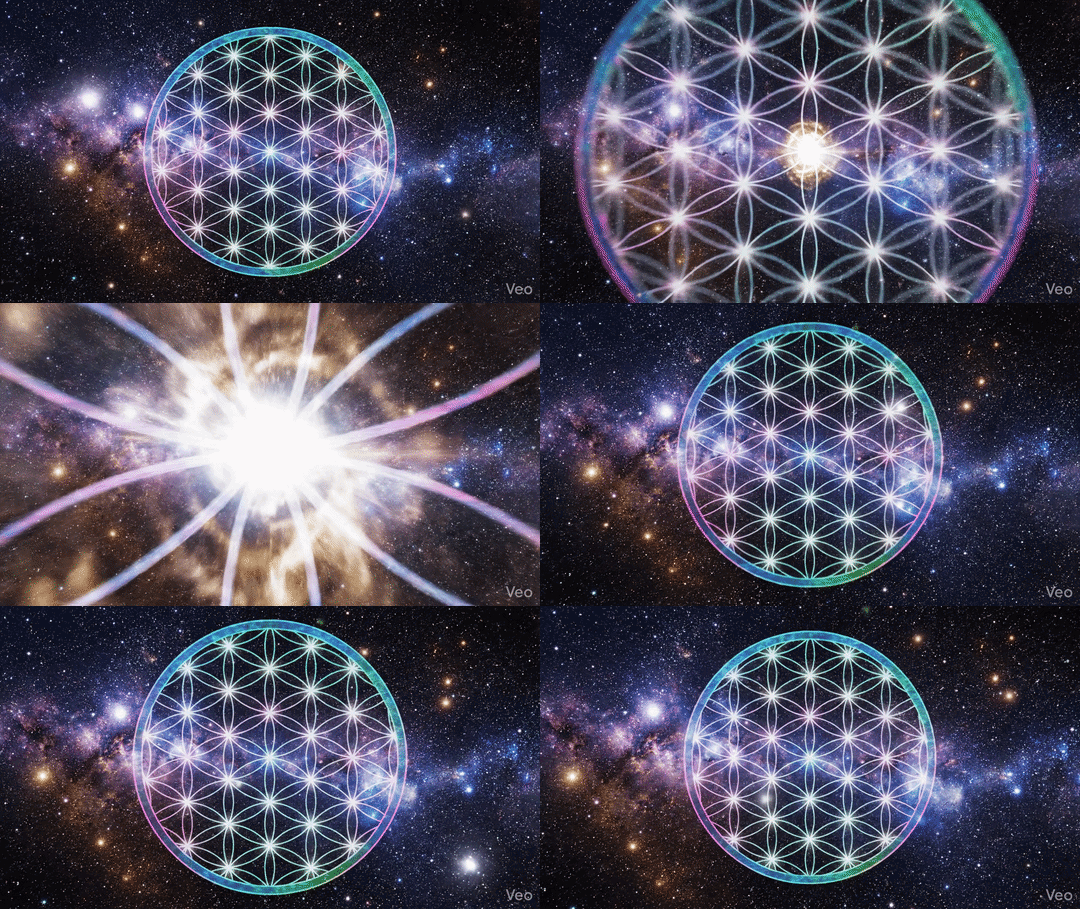
In the language of design thinking:
How might we co-weave [an ‘Indra’s net’ of] the world’s mystical traditions that re-sensitizes the heart of humanity to the sacred?
I invite to join me on this unfolding journey.
Nipun Mehta makes a helpful distinction between ‘big data’ and deep data’ in the age of AI: “AI excels at what we might call big data—the conscious, capturable, calculable information that lives on the surface of our lives. Every click, every purchase, every word we type. Machines can find patterns in this data that no human could see.
But there is another kind of knowing. Call it deep data—the wisdom encoded in our bodies, our intuitions, our unconscious processing. The monarch butterfly doesn’t consult a map—it navigates three thousand miles by something encoded in its cells. The gut feeling that something is wrong arrives before the reason why. Your heart knows before your mind does”
The Pali word mano is typically translated as ‘mind’, though here it is translated by Bhikku Sujato as ‘intention’. Bhikku Sujato explains: “Mano here has its usual role as the active aspect of mind, effectively meaning kamma. Translating as ‘mind’ obscures the ethical reading in favor of an idealistic one, which given the remainder of the verse is surely not justified.”
Cynthia Bourgeault comments: “Gurdjieff’s image of “the sorrow of our Common Father,” quietly radiates his conviction that the One who has called all existence into being is moved by this ineradicable quantum of suffering which seems to be an inherent part of the finite order. God is no monster; He is our “common Father,” who is as bound by the terms of existence as we are ourselves and feels them with, if anything, an ever greater magnitude of anguish.
Other spiritual teachers may speak of the Divine Source as a great, transpersonal “it.” Not Gurdjieff. The reason for his perhaps shocking tenderness here is not that he literally believes in a “Big Daddy in the Sky,” but that he knows full well that only in the domain of the personal can we humans find the courage and generosity of heart that allows us to take this next step.
If we can find our way to this deeper “yes,” our life immediately moves beyond the horizontal axis — beyond the sphere of our personal wants and needs and even the debt owing for our individual arising — and onto the vertical axis, where we begin to carry a bit of that cosmic “cost of arising.”
So named after the location of the first conference and many subsequent conferences: St. Benedict’s Monastery in Snowmass, Colorado
Indra’s net (Sanskrit: Indrajāla) is a Buddhist/Vedic metaphysical metaphor demonstrating the interpenetration of all phenomena. Indra’s net stretches out infinitely in all directions, wherein each nexus point is adorned by a celestial jewel. Each jewel reflects all other jewels in the net, ad infinitum. The image of each of these limitless jewels is within one jewel.
Oh my Moses. thank you so much for this beautiful offering. I will read and listen to it often, contemplate, and pass it on to my spiritual friends. Great great benefit. I bow my head to you in respect and love. Thank you.
Hi Moses, this was an interesting read. You're obviously interested in exploring reality and writing about it :) Someone once told me "Realising the truth will set you free, but conceptualising that realisation will shut you down". You write fluidly and are able to weave and connect different ideas, but I know from my own very painful experience that this skill is very much a double edged sword. Any robe we wear is fresh for a time but the freshness wears off quickly... I wonder how prepared you would be to also surrender the identity of the "modern mystic"?